
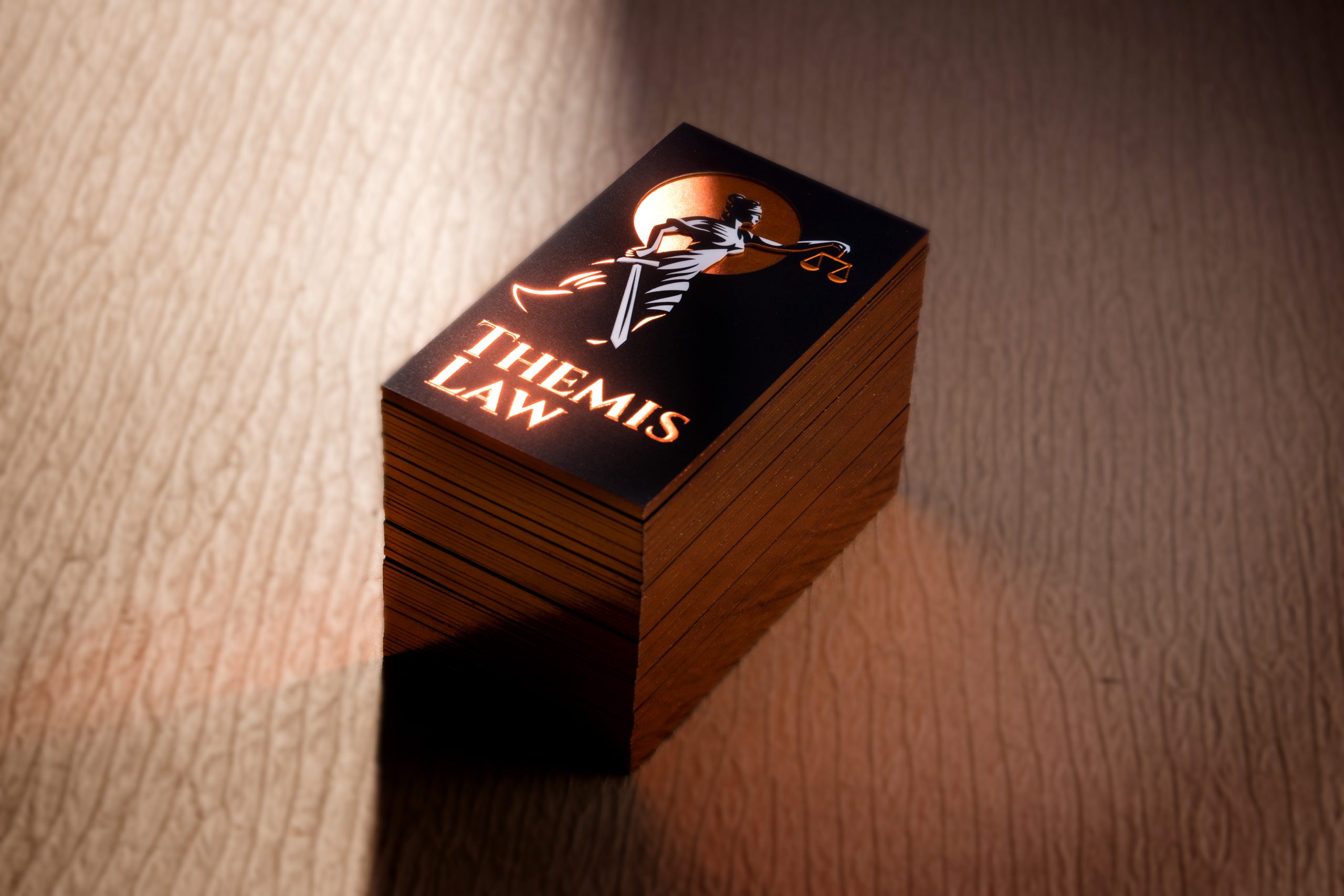
What “Premium” Actually Means — The Manufacturing Answer
Every competitor in this space uses the word “premium.” Almost none of them define it. A card is premium because of what happens in the manufacturing process, not because of what the marketing copy claims — and those two things are rarely the same.
The weight of a business card is measured in points (pt), where one point equals 1/1000 of an inch. A standard office business card is 14pt to 16pt. The card flexes. It bends back to near-flat after being slipped into a wallet. This communicates disposability because it behaves like something disposable.
A luxury attorney card begins at 32pt. At 32pt, a silk-laminated card has a flex-resistance more than twice that of a standard card. It does not bend convincingly under thumb pressure. It sits in the hand with the same density as a retail gift card. At 48pt — a three-layer construction where two sheets of premium stock are bonded around a colored core — the card is approximately 1.2mm thick, closer in feel to a hotel key card than to a paper product. You can read that density as investment. Your client will.
The lamination process matters as much as the weight. Silk lamination applies a thin polyester film to the card surface under heat and pressure. This creates a finish that is smooth without being glossy, resistant to fingerprints, and dimensionally stable. “Luxurious feel” is not a design choice — it is a manufacturing outcome.
If you are thinking about premium business cards as a category for your firm, the specification decision starts here: weight and lamination before design.
The Right Paper Stock for Your Practice Area
Not all attorneys need the same card. The authority signal an estate-planning partner must project is measurably different from the authority signal required by a trial lawyer or a corporate M&A attorney, and the paper stock should reflect that difference.
Estate-Planning and Trust Attorneys
Estate-planning and trust attorneys operate in a practice area built on fiduciary gravitas. The client is committing the most consequential legal decisions of their life to this relationship. Here, 100% cotton letterpress is the specification. Cotton paper is made from cotton linters rather than wood pulp. This gives it a soft, fabric-like texture that reads as old-world quality. When the firm name is letterpress-printed — physically pressed into the cotton surface with an impression die — the result is debossed text with tactile depth no standard printed card can replicate. An estate-planning attorney holding a cotton letterpress card signals fiduciary seriousness before a word is exchanged.
Corporate Counsel and M&A Attorneys
Corporate counsel and M&A attorneys operate in environments where precision and modernity carry more weight than tradition. For these attorneys, 32pt or 48pt silk-laminated duplex stock is the right specification. This two-layer bonded stock can optionally feature a contrast-color core visible at the card edge, projecting weight and restraint. Suede lamination is a strong alternative: silk produces a smooth hand, while suede produces a soft-touch velvety surface that reads as deliberate. Either way, the card does not announce itself loudly. It announces itself by weight.
Litigation Attorneys
Litigation attorneys often benefit from a bolder specification that projects confidence without subtlety. Matte black 32pt stock with real gold or silver foil stamping has earned its own authority signal. It works in rooms where confidence is the currency. Edge painting — a painted or foiled application to all four edges of the card — is particularly effective for trial lawyers. When a stack of cards is held together, the edge color appears as a solid stripe. It reveals itself only on close examination, rewarding attention rather than demanding it.
For a broader comparison of how these stock specifications translate across other professional service contexts, see our guide to premium cardstock weights and how they are applied across industries.
Finish Options Compared — Foil, Letterpress, Silk Lamination, and Suede
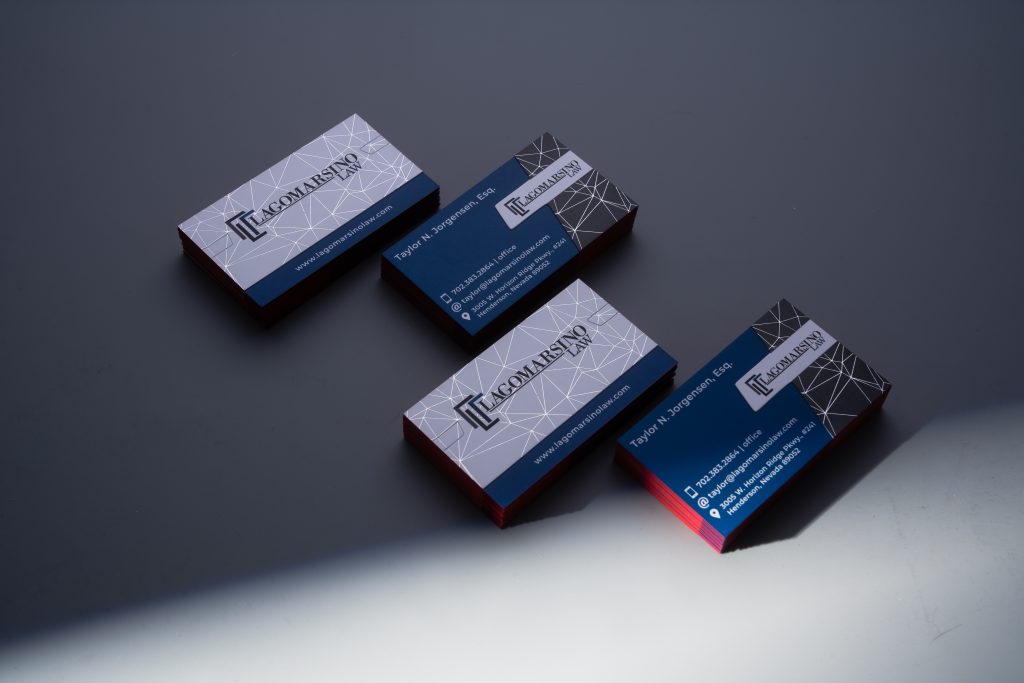
Understanding the finish options available for luxury business cards for lawyers requires separating what each process does physically from what it communicates perceptually.
Foil Stamping
Foil stamping presses a metallic foil sheet into the card surface using a heated die. The result is a reflective, crisp-edged area — gold, silver, copper, or black — with slight embossed depth. This is not metallic ink, which fades with handling. Real foil retains its brilliance because the metallic layer is a physical transfer, not a coating. For firm names and monograms, gold foil on a dark matte ground is the proven specification in elite legal practices.
Letterpress
Letterpress is the oldest finish in this guide and the one that ages best. The process uses a relief die pressed directly into thick paper stock — typically 100% cotton. This leaves a physical impression that is visible, tangible, and permanent. It does not rub off. It does not chip. For attorneys whose practice emphasizes continuity and tradition, letterpress communicates those values at the material level rather than the visual one.
Silk Lamination
Silk lamination is the workhorse of the luxury range. It is a matte polyester film applied to the card surface, creating a smooth, fingerprint-resistant satin finish. Its restraint is its strength. It does not announce itself the way foil does. Instead, it communicates quality through consistency of texture. That quality reveals itself over a meeting rather than in the first glance.
Suede Lamination
Suede lamination achieves a soft-touch velvet-like finish through a specialized micro-texture applied during the lamination process. Where silk reads as professional, suede reads as considered — the choice of an attorney who has thought carefully about how the card should feel in the recipient’s hand, not just how it should look.
These finishes can be combined. A 32pt suede-laminated card with selective spot UV on the firm name — where a high-gloss clear coat is applied only to specific areas, creating a texture contrast that shifts on tilt — produces a specification that reveals depth on closer inspection. This is the “rewards attention rather than demanding it” principle applied to print finishing.
Want to feel the difference yourself?
SilkCards offers free sample packs containing all premium finishes — silk lamination, suede lamination, letterpress, foil stamping, and edge painting. Specify yours before you commit to a press run.
How Thick Should a Lawyer’s Business Card Be — And Why the Number Matters
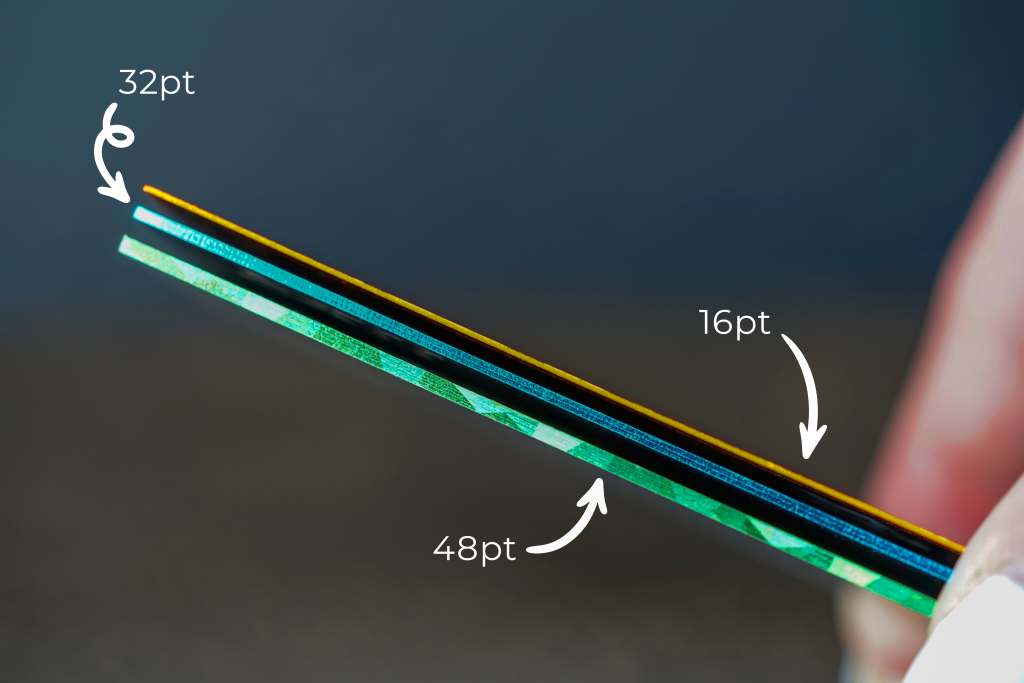
The standard business card distributed at legal conferences is 14pt to 16pt. SilkCards offers attorney cards starting at 22pt (Onyx Black Suede) up through 48pt three-layer construction. The difference is not cosmetic.
At 16pt, a card deflects under mild thumb pressure. With 32pt silk lamination, the same pressure produces no visible deflection — the card behaves like a rigid object. The 48pt three-layer construction brings the card to approximately 1.2mm thick, giving it the dimensional presence of a financial-grade card. When a client slips a 48pt attorney card into a cardholder alongside other cards, it does not disappear. It projects.
The manufacturing reason for this rigidity is the lamination bond. When two layers of premium stock are cold-fused and then laminate-pressed, the resulting sandwich resists delamination and flexion along the bond plane. The card does not merely feel thick — it is structurally thick, and that structural quality is what the hand registers as substance.
For attorneys who present to institutional clients — pension trustees, corporate boards, high-net-worth estate clients — the card weight is a data point that gets registered even when it is not consciously processed.
The Details That Signal Authority Without Announcing Themselves

The details that carry the most authority on an attorney’s business card are rarely the ones that shout. They are the ones that a client discovers on second examination.
Edge Painting
Edge painting applies a colored or metallic finish to all four card edges. On a 32pt or 48pt card, the edge is a visible plane — approximately 0.8mm to 1.2mm wide — wide enough to carry detail. A white card with deep navy edges, or a black card with gold-painted edges, communicates something about the attorney that a conversation cannot: that the standards this firm applies extend to the parts of things that are not immediately visible.
Embossing and Debossing
Embossing and debossing create raised or recessed areas on the card surface without ink. A firm seal debossed into the card face — pressing the design slightly below the surface level — produces a tactile element that the hand discovers independently of the eye. It is the difference between a card that looks like it was designed with care and a card that was manufactured with care.
Spot UV Coating
Spot UV applies a high-gloss clear coat to selected elements — a firm name, a watermark pattern in the card background, a monogram — over a matte laminated surface. The contrast between matte and gloss creates a shift effect: at one angle, the spot UV element disappears; at another, it catches the light. It is the finish equivalent of a watermark on legal paper.
One note on card design and professional ethics: if your card includes any descriptor like “specialist” or “expert,” be aware that most state bar advertising rules — including those derived from ABA Model Rule 7.2 — restrict these terms to attorneys who hold an official certification from a recognized body. A card that says “Board Certified Estate Specialist” is compliant where the certification exists; one that uses “specialist” informally may not be. The finish specification of your card is entirely yours to choose. The language on it should be reviewed against your state bar’s advertising rules before going to press.
For attorneys in related premium professional service contexts, the same specification logic applies — see our guide to luxury real estate business cards for a parallel treatment of finish choices across high-trust professions.
Ordering Luxury Business Cards for Your Law Firm — What the Process Looks Like
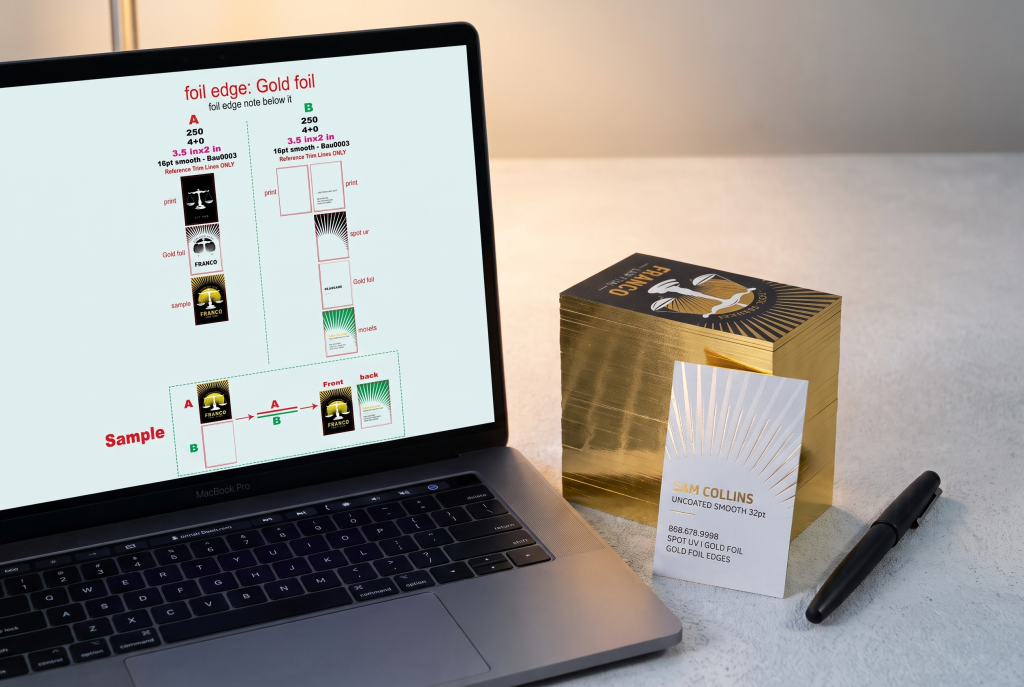
The Specification and Ordering Process
The specification process for a luxury attorney card is more precise than for a standard print order, and it should be. The decisions made at the specification stage — stock weight, lamination type, foil color, edge finish — determine the physical experience the card produces, and those decisions cannot be revisited once the press run starts.
At SilkCards, the ordering process begins with stock and finish selection before design. This sequence matters because the design choices that work on a 32pt suede card are different from those that work on a 48pt cotton letterpress card. The stock is the canvas; the design follows from it, not the other way around.
A recent SilkCards buyer who specified a premium card described the process this way: “She walked me step by step through the specification selection process, and gave insight into what to expect with each one.” For attorneys accustomed to the same meticulous attention to detail they apply in practice, the specification conversation is the part of the print process that maps most closely to how they work.
Turnaround and Firm-Wide Orders
Standard turnaround for luxury attorney cards is five business days from approved proof. Free sample packs are available to verify finish and weight before committing to a full press run — an option that matters when the specification decision involves a 48pt stock a buyer has not previously held.
For attorneys ordering for an entire firm — multiple partners, associates, of counsel attorneys — the specification process accommodates variable name printing (different names, titles, and contact information across a single press run) at the same stock and finish specification, maintaining brand consistency across the firm without requiring separate setup fees for each name. When you are ready to order luxury attorney business cards, the sample pack is the right starting point.
Quick Reference: Luxury Card Specifications
| Manufacturing claim | What it means in the buyer’s hand | Why it signals authority |
|---|---|---|
| 32pt silk lamination | Flex-resistance more than 2x a standard 16pt card — the card does not bend under thumb pressure | Rigidity reads as permanence; permanence reads as legal credibility |
| 48pt 3-layer construction | Two sheets of premium stock bonded around a colored core, ~1.2mm thick | Card density signals investment; the weight is registered before the name is read |
| 100% cotton letterpress | Soft fabric-like texture from cotton linter paper; text pressed physically into the surface with a die | Tactile depth that cannot be replicated by printing; old-world prestige for trust & estates attorneys |
| Edge painting | Painted or foiled application to all four card edges — visible on the 0.8mm–1.2mm edge plane of a thick card | Detail discipline that rewards close examination — signals standards that extend beyond the obvious |
| Real foil stamping | Metallic foil transferred under heat and pressure — not metallic ink; retains reflectivity through handling | Tradition without ostentation; gold foil on matte dark stock is the specification of elite legal practice |
| Spot UV | High-gloss clear coat applied selectively over matte lamination — creates a tilt-shift reveal effect | Texture contrast that reveals at second glance; the print equivalent of a legal document watermark |
| 5-day standard turnaround | Press-controlled production at the SilkCards facility, approved proof to shipped card | Reliability that matches the time-sensitivity of firm launches, bar admissions, and partner promotions |
“A recent SilkCards buyer who specified a premium card described the experience: ‘She walked me step by step through the specification selection process, and gave insight into what to expect with each one.’”
What to Expect at Each Step
Attorneys are professionally trained to interrogate the details of any specification before committing. The SilkCards process is designed to match that instinct — the specification conversation exists to produce a card that performs exactly as intended, because a card that surprises you when it arrives from the press is a specification failure, not a design success.
Frequently Asked Questions
Do lawyers still use business cards?
Yes — and the function of a lawyer’s business card has become more specific, not less relevant. In an era when contact information lives in every phone, the physical card signals something that a digital exchange cannot: that the attorney treats every client interaction as a material event worth investing in. For estate-planning attorneys meeting with high-net-worth families, for corporate counsel introduced at board meetings, and for litigation attorneys exchanging cards with opposing counsel, the physical card is a controlled communication about professional standards. The specification of that card — stock weight, finish, and construction — is where that communication is made.
What paper weight should a lawyer’s business card be?
A minimum of 32pt is required for any card positioned as premium. At 32pt silk lamination, the card has the structural rigidity and hand-weight that separates it from a standard printed card. For attorneys in trust and estates, private wealth, or senior partner roles, 48pt three-layer construction or 45pt cotton letterpress elevates the specification further. The card becomes an object rather than a slip of paper. Standard office cards printed on 14pt to 16pt stock communicate nothing about quality — they behave like the disposable item they are.
What is the difference between foil-stamped and letterpress lawyer cards?
Foil stamping presses a real metallic foil — gold, silver, copper, or black — into the card surface using a heated die. This produces a reflective, crisp-edged element that retains its brilliance through handling. It is the right specification for firm names, monograms, and insignia where metallic authority is the intended signal. Letterpress presses a relief die directly into thick paper — typically 100% cotton — leaving a physical debossed impression with no reflective element. It signals tradition, craft, and permanence through tactile depth rather than visual shine. Both are premium specifications. The choice depends on whether the attorney’s brand calls for contemporary authority (foil) or historical gravitas (letterpress).
How long does it take to order luxury business cards for a law firm?
Standard turnaround at SilkCards is five business days from approved proof to shipped cards. The specification and proofing process typically takes one to three business days, depending on finish complexity. Foil and edge painting require additional press setup verification. Free sample packs are available on request, allowing attorneys to verify the exact stock and finish before approving a full press run. For firm-wide orders covering multiple attorneys, variable name printing is accommodated within a single press run. This maintains consistent specification and turnaround across the full order.
Ready to specify your firm’s cards?
Begin with stock weight and finish — the design follows from the canvas, not the other way around. Our specification team walks every attorney through the process, from sample pack to press-approved proof.
About the Author
Henry Fan is the founder of SilkCards, a premium business card manufacturer he established in 1999. With 27 years specifying premium cards for professional service firms — including law firms, financial advisors, real estate brokerages, and luxury hospitality brands — Henry brings deep manufacturing expertise to the question of how a printed card communicates authority. He has personally guided thousands of attorneys, consultants, and brand executives through the specification process from stock selection to finishing.