
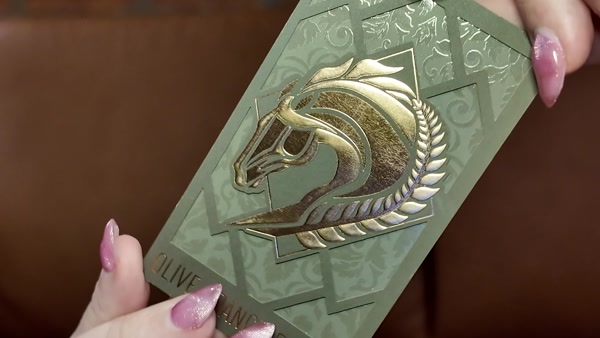
The moment luxury business cards change hands, the room makes a decision.
Not a conscious one. That decision happens in the half-second before the recipient has processed the design, before they have read the name, before the conversation has technically begun. A card arrives. The room responds. Weight, surface, resistance between the fingers — every physical signal arrived in sequence, carrying information about the person who handed it over.
SilkCards builds 32pt business cards by bonding two individually laminated 16pt sheets — every layer finished in Suede, Silk, or Linen, all the way through. That construction, therefore, is the standard most professionals searching for luxury business cards have never been offered. This article explains why, and what the difference feels like.
Most professionals who order “luxury business cards” are trying to own that half-second. Most of them are not getting the card they believe they ordered.
This is not an indictment of their research. It is a documentation of how the online print industry defines luxury — and what that definition quietly leaves out.
What the Print Industry Means by “Luxury Business Cards”
Every major print company has a premium tier. The names vary — Luxe, Elite, Pro, Ultra — but the premise is uniform: a thicker card signals higher quality.
They are not wrong about the premise. Thickness registers in the hand. A 32pt card has a weight and stiffness that a standard 14pt card cannot replicate. The heft communicates something real before the design is read.
However, thickness is where most luxury business cards end.
The lamination — the surface layer that gives a card its texture, its resistance, its scuff protection — is where the distinction lives. At 16pt, nearly every major online printer offers lamination options: soft-touch matte, silk, or suede finishes. The catalog looks generous. Then, above 16pt, nearly all of them stop.
Their 32pt card is paper. Pre-manufactured, uncoated, unfinished at the substrate level. The paper mill made the construction decision. The printer received a finished sheet, applied ink, and sold the result as luxury.
This is the Invisible Ceiling on luxury business cards. The gap between what the industry offers and what genuine premium construction feels like is not visible in a product photo. It reveals itself the first time someone holds both side by side.
32pt — What the Number Actually Tells You
At 32pt, a card is roughly twice the thickness of an industry-standard 16pt card. That is the verifiable fact, and it is where consensus on “luxury” typically begins and, for most printers, ends.
What 32pt does not tell you: what the card is built from.
Nearly every major online printer sourcing a 32pt card uses pre-manufactured mill paper — Mohawk Luxe, Mohawk Superfine, or an equivalent substrate produced by paper mills specifically for the printing trade. The paper mill set the construction parameters. Their printer received a sheet and applied ink.
What results is a card that is thick. That, simply, is all.
The same finish restrictions that limit treatment availability at 16pt apply here, and sometimes worsen. Foil stamping on uncoated stock requires different adhesion conditions than foil on laminated stock. Spot UV adheres differently. Embossing reads differently. Competitors market it as premium. The substrate beneath the ink says otherwise.
Thickness is a number. Construction is what the hand reads. It is also what separates luxury business cards that perform from those that merely look the part.
The Silk Standard: What Luxury Business Cards Are Actually Missing
Most business card printers offer 32pt stock as their premium tier — but at that thickness, they use uncoated pre-manufactured mill paper. SilkCards pairs 32pt+ with suede lamination as its standard — a combination no other online printer offers.
The distinction is not a finish option or an upgrade. It is, in fact, a construction method.
SilkCards bonds individual 16pt sheets together. Each sheet carries its surface finish — Suede, Silk, or Linen — before bonding occurs. At 32pt, the card is two fully laminated sheets, each finished, each treated, bonded into a single structure. Add a third sheet and you have 48pt. A fourth brings it to 64pt.
Every layer carries a finish. No bare paper anywhere in the build.
This is the Silk Standard, and it is why SilkCards cards feel categorically different from other 32pt cards the first time someone holds one. Not a degree of difference. A kind of difference. The suede surface extends from the front face through the build — it does not sit on top of something else. Your hand knows this before your eye reads the design.
Verify it simply: run a thumb from the card’s center face to its edge. On a properly laminated construction, the texture is uniform all the way to the edge. The finish bonds through the substrate — nothing sits on top of something else. On a card built from mill paper with a surface coating, there is a transition — the coating is on top of something, and the something is different from the surface.
Notice it once and it stays with you.
Why Suede at 32pt Changes How Luxury Business Cards Feel
Suede lamination is a soft-touch matte surface — velvety, scuff-resistant, with a tactile quality that synthetic alternatives cannot replicate. It is the most popular finish in the SilkCards catalog. The reason is consistent: it is the finish that produces the reaction.
“I’ve never felt a card like this.”
That sentence comes from the hand’s encounter with suede on a properly constructed luxury business card. Not from the design — which could be anything. From the material itself, speaking before a word is read.
For a CEO handing a card to a prospect, for an attorney across a table from a new client, for a realtor in a listing presentation — the half-second before the card is examined is the moment that counts. Suede on a 32pt laminated construction delivers a physical signal in that half-second that uncoated mill paper cannot produce at any thickness.
“I always get my logo laser cut into the card’s back, which when you hand it to someone, it has that tactile response of oh Wow — they weren’t expecting that. Today, I just up-ped my game by adding suede to the front.”
— Randy Gilbert | ⭐⭐⭐⭐⭐ | Google Reviews | December 5, 2025
What Laminated Construction Makes Possible That Mill Paper Cannot
A fully dressed suede construction at 32pt keeps every post-print treatment available. This is the practical consequence of the Silk Standard that no luxury business card competitor mentions, because no competitor can claim it.
Foil stamping. Spot UV. Embossing and debossing. Edge painting and edge foiling. On a 32pt card where every layer is laminated, all of these are possible across the full face, at full design freedom, without restriction.
On uncoated mill paper, the lamination is absent — and with it, the surface adhesion that makes these treatments hold cleanly. Foil does not stamp on raw stock the way it stamps on laminated substrate. Spot UV doesn’t adhere at the same precision. The card can be thick, but it cannot be thick and fully finished in the same build. That combination does not exist in the mill-paper construction model.
This is why a SilkCards 32pt Suede card can carry gold foil on a suede substrate, spot UV on specific design elements, and a foil or painted edge — simultaneously, at full design freedom, on a single card. The construction makes the canvas.
The Full Finish Range — Only Possible on Laminated Construction
In total, SilkCards runs 38 foil options across five distinct finish families, with up to 7–8 foil colors on a single card face. Specifically, that range is not just a catalog decision — it is possible because the laminated construction actually supports the adhesion those finishes require. Additionally, foil and UV on SilkCards cards rise in elevation through multiple print passes — registering under the thumb before the eye identifies the source. As a result, no other online printer operates at this elevation range.
→ For a complete breakdown of the foil system: Foil Business Cards — 38 Colors, 5 Families, and Why Most Printing Stops at 4
What Else Opens Up at True Thickness
Beyond the Silk Standard, genuine construction at 32pt and above makes other things possible that pre-manufactured mill paper cannot support.
When individual 16pt sheets are bonded rather than a mill-spec thick sheet purchased, each layer is independently designed. Interior layers can be a different color — exposed through precision die-cut windows cut into the outer layer. Foil sits between layers, visible only through the architecture above it. A 48pt build can carry three distinct design surfaces in a single card.
Edge treatment becomes meaningful at true construction thickness. At SilkCards, 24 painted ink colors and 36 foil edge options — including metallic, pearlescent, and spectrum-shifting finishes — go onto edges thick enough to carry them visibly. The edge is not a byproduct of thickness. It is the fifth design surface of the card.
Alternative substrates — real wood veneer in beech or cherry, metal, cotton fiber — are available under the same construction logic, each arriving with a sensory identity before a designer touches it.
“I wanted people to keep my card because it was so nice. In fact, I had several people say ‘now THIS is a business card!'”
— Cristina Terzes | ⭐⭐⭐⭐⭐ | Google Reviews | November 21, 2025
→ View the full Suede business card range at SilkCards
The Card That Walks Into the Room Before You Do
A professional’s reputation is built from signals. The way they present themselves. What objects carry their name. Which materials they trust with their first impression.
A card is the first physical proof the room receives that something about this professional is worth a second look. For the CEO, the realtor, the attorney — the card is not a formality. It is a weapon, and it is deployed before a word is spoken.
A luxury business card built from individually laminated layers, finished in suede, carrying foil or texture or a treated edge, delivers a specific signal in that half-second: this person pays attention to things that matter. The card is not an accident of volume pricing. SilkCards chose it.
SilkCards has built cards to this standard since 1997 — over 25 years, one conviction, no shortcuts in the construction. The Silk Standard is not a tier or an upgrade. It is the floor beneath everything that follows from it.
The room already knows the difference. The hand already knew it first.
Frequently Asked Questions
A standard business card is typically 14pt to 16pt. At 32pt, a card is roughly twice that thickness, producing noticeably greater weight and rigidity. The more important distinction is construction: most 32pt cards from major online printers are built from pre-manufactured mill paper — uncoated, unlaminated, with no finish bonded to the substrate. SilkCards produces 32pt cards by bonding two individually laminated 16pt sheets, so both layers are finished in Suede, Silk, or Linen throughout. The thickness is the same. What the hand finds underneath is not.
Suede lamination is a soft-touch matte laminate bonded to the card substrate — not printed on it. The result is a velvety surface that resists scuffs, repels fingerprints, and has tactile resistance that the hand identifies before the eye reads the design. SilkCards applies suede lamination to every layer in a multi-layer construction, including interior layers, so the finish is present throughout the card structure — not only on the face.
Construction, Finish & Feel
Foil stamping adheres best to a laminated or coated surface that accepts the metallic foil under heat and pressure. At 16pt, most printers use laminated stock — which supports foil cleanly. Above 16pt, most printers switch to pre-manufactured mill paper, which is uncoated. The coating that makes foil work is no longer present. SilkCards produces 32pt and thicker cards from individually laminated sheets, maintaining that coating throughout — which is why foil, spot UV, embossing, and edge treatments remain available at any thickness in the build.
A card built from laminated construction at 32pt has three physical qualities that distinguish it immediately: weight that registers as density rather than stiffness, a surface texture that the hand identifies before the eye reads it, and edge character that reflects the precision of a built structure rather than a cut sheet. The SilkCards 32pt Suede card is the one customers describe as the card they hesitated to hand over — not from uncertainty, but because holding it longer than necessary is a natural response to something built at this level.
The Room Has Already Decided
The professionals who order the right card are not always the ones who know the most about printing. Instead, they are the ones who hold the card, notice that something is different from everything they have held before, and understand what that difference communicates about them.
By contrast, every other 32pt card is a number stamped on a paper specification.
This one is a built object. Finished throughout. Capable of carrying any finish, any foil, any edge treatment at full design freedom — because the construction underneath earns it.
The room reads all of this in the half-second before the conversation begins.
That is the half-second worth owning.
Feel the Silk Standard before you decide. Request your free SilkCards sample kit — 32pt Suede in your hand, along with the full finish and foil range, sent to your door.