
Written by Henry Fan · Founder, SilkCards
27 years turning ink, foil, and pressure into first impressions that don’t get forgotten.
[HERO IMAGE GOES HERE — see Section 3 of silkcards-package-designer-pillar-2026-05-24.md for spec]
A Letter Before the Counsel
This is not a buyer’s guide to business cards for graphic designers. It is not a list of templates. It is a letter from one craftsman to another, written at a moment when the craft itself is shifting under our feet.
Designline Graphics started in 1997 as a graphic design service. SilkCards registered in 1999 as a print service after three small businesses in a row taught me what their checks already knew — that the print, not the design, was the front-facing product their customers held. I have spent the twenty-seven years since on the production floor, watching what a finished card does to a room when it lands in the right hand.
What follows is what I would tell a designer sitting across from me in 2026, about business cards for graphic designers and the wider conversation behind them. About AI, print, and the specs that decide a card before anyone reads the name. About the relationship between a designer, a print partner, and the client who never has to know either of us by name.
In This Article
- When AI Can Design, What Can a Designer Sell?
- A Print Manufacturer Who Used to Be a Designer
- The Invisible Ceiling Most Designers Don’t Know Exists
- What Becomes Possible Past the Ceiling
- Why We Are Not for Everyone (and Why That’s the Point)
- The Alliance — How Designer Relationships Become Partnerships
- The Deeper Offer — Why Designers Come Back
- How to Test Drive SilkCards
- Frequently Asked Questions
When AI Can Design, What Can a Designer Sell?
When designers first discover SilkCards, they don’t just see a business card. They see a new creative playground.
That is the first thing I want to put on the table, because the rest of this letter only makes sense if you allow yourself, for the length of this read, to suspend what you think a business card is. Traditionally, a business card, for most of your career, has been a deliverable. A 3.5 × 2 rectangle that closes out a brand identity at the bottom of the invoice. Essentially, the thing the client wants made fast and cheap because they think it’s a giveaway.
However, the 2026 market is going to force every designer reading this to reconsider that frame. And it will not do so gently. Certainly, prompt-driven design tools can now generate a usable logo in forty seconds and a passable identity system in an afternoon. Clients know it. They have tried it. Indeed, some of them have already cancelled the retainer.
The AI Squeeze and What It Cannot Reach
In short, that is the squeeze. AI is not coming for the craft. It is coming for the parts of the craft that were already commoditized. Those are the things a competent template-driven workflow could already produce. And it is pricing them at zero. What it cannot come for is the dimension you cannot show through a screen. It cannot come for thickness. The way a foil edge catches a tungsten bulb — how that edge shifts color when the wrist turns — is beyond any screen. The small, repeatable sound a 32pt card makes against a polished tabletop lives in the physical world. Ultimately, what a client’s fingers learn about your work lands in the first half second, before their eyes catch up.
The Dimension AI Cannot Reach
That dimension — the tactile, the structural, the physical — is where designers still have ground that AI does not.
This is the conversation I have been wanting to have with designers for two years, printing 20,000 mailers about it. I have been waiting to write this article. Specifically, the goal is simple: when a designer reads it, they have a partner across the page. Not a vendor with a coupon. A designer who lived this pivot once. Indeed, twenty-seven years ago, the technology of the day pulled the ground out from under design service businesses. Notably, that earlier shift had the same shape as the AI shift is having now. That is the counsel on offer. The way through is into print. Specifically, into premium tactile print — the kind a client cannot reproduce by typing a prompt and clicking generate.
A Print Manufacturer Who Used to Be a Designer
First, you should know how I got here. The lesson is not academic to me.
1997 — Captain Alex Seafood and the design fee lesson
My first signal came from a small fish market in Niles, Illinois. Captain Alex Seafood. They wanted a postcard sized differently than a standard mailer so it would stand out in the mailbox. I designed it. I quoted the design fee. Before they even reacted to the fee, the owner asked if I knew a printer to run 50,000 postcards and a mail house to deliver them. I said yes to both. He said, take the design fee out of the deal — handle the design, print, and mail — and we have a deal.
Being a hungry start-up, I agreed. That small job generated a margin on the print and mail service. The design itself, the thing I had trained for, was the part the client wanted free.
1998 — KEIM Furs and the layout-only contract
The pattern confirmed itself a year later. Mr. Keim of KEIM Furs in Chicago wanted a forty-eight-page luxury catalog printed on premium stock. He had the photography. His brand was already established. When we met, he told me plainly: Henry, I am not asking for design or anything creative. I just need your help to put the photos from the film onto the computer and lay out the pages. It was scanning film and arranging photos. Skilled work, but layout work, not creative work. The premium print was where the project’s value sat for the client. The design service was a courtesy I provided so the print would land cleanly.
We became friends. He sent me more projects. He is one of the reasons SilkCards exists.
1999 — The crucible: a major publishing company puts everything at risk
The decision did not come from those projects. It came from one project that nearly broke the business.
A sponsored art book. The artist called and asked for a cover design. His sponsor was a major publishing company. That category was sensitive. The stakes were enormous. I designed several variations of the cover. The work was real and the hours were real. The artist approved the design. Then he asked if I could find a printer for the book. If I did, would I waive the design fee in exchange for the print contract?
The design fee had already been collected from the sponsor. Saying yes meant forfeiting my piece of it. The print job was substantial enough that I said yes anyway and took it. Sleep was hard to come by for the next six months. First, the press proofed the job. His signature went on it. Everything printed and shipped on schedule. That timeline would have put my entire young business under if anything had gone wrong. I did not have the capital to cover a reprint at that scale. If the publishing company had rejected the finished books, my business would have ended.
The job delivered. Books shipped. The publisher accepted them. I lay down on the first night I slept through after the publisher approved the book. Then, that night, I made a decision that has carried every project since.
The pivot decision
That night, a decision formed: pivot to offer print service first, design as a secondary add-on.
Twenty-seven years younger than I am writing this, By that point, I had spent two years watching clients. They consistently valued the tangible front-facing product over the creative service. Six months of insomnia taught me that print is where the financial exposure is, and therefore where the business has to either invest or exit.
I chose to invest and built a manufacturing relationship that became the partnership network behind SilkCards. The design service closed. Therefore, building what we now print began.
I am telling you this for one reason. The squeeze you are feeling from AI in 2026 has the same shape as the squeeze I felt from clients in 1997. However, your path through it is faster than mine was. All the manufacturing infrastructure you need to specify against already exists. I spent the next two decades assembling it. It exists at SilkCards. And I am not the only one who built one. There are a handful of print houses worldwide that can do what I am about to describe. We are not the only path. We are one of the credible paths.
The point is that you do not have to abandon the craft. You have to move it up the value chain into the dimension AI cannot reach.
The Invisible Ceiling Behind Most Business Cards for Graphic Designers
In fact, most designers are working inside a ceiling they have never seen.
You design business cards in 2D because the manufacturing you have access to is 2D. Flat paper. CMYK. A matte or gloss laminate. Maybe a single foil color if the client has the spend for it. You do not think about thickness because thickness has been a fixed industry parameter for as long as you have been designing. The defaults are 16pt, sometimes 32pt, almost always uncoated above 16pt. The finishes you have used at 16pt do not survive at the heavier weights at most print houses.
You do not think about face die cuts because the die cut services you have specified only cut the edges. You do not think about foil-on-foil or foil-and-spot-UV on a single face because the platforms you have used force a choice between them.
This is the invisible part. You are designing inside a constraint set that the manufacturing layer imposed, and because the constraint set has been stable for so long, you have come to believe it is the medium itself. It is not. It is one available version of the medium. There are others.
The Third Dimension in Card Design
The dimension you have not been designing in is the third one. Thickness as authority. Suede or silk laminate carried through that thickness instead of stopping at 16pt. A foil edge that runs around the perimeter of the card as a designed surface. Multi-color foil used as illustration rather than accent. Additionally, die cutting through the face of the card reveals the interior layer’s color as a deliberate compositional element. Spot UV laid directly on top of foil. The gloss reads against the foil surface rather than against the paper. Variable elevation, where one element on the card sits at twice or three times the height of another. The fingertip registers the design before the eye returns to the type.
Of course, none of those are tricks. They are dimensional craft. They take the same compositional eye you already use for layout and color and apply it to a vocabulary you have not yet been given.
A designer who once said it best — and this is the line I keep on the wall at our office — described their first SilkCards experience this way: I can actually design with the card itself and not just the face of it.
That sentence is the entire pivot. The card itself, not just the face of it.
What Becomes Possible Past the Ceiling
The ceiling is one specification. However, once you cross it, a cascade follows.
The 32pt Suede or Silk floor
The single spec that opens the door for designer-grade work is a 32-point card that holds a suede or silk laminate through every layer of its thickness. Most print houses can produce a 32pt card. The trick is what happens to the finish at that thickness. The mainstream way to get to 32pt is to use an uncoated premium paper. That is a Mohawk-style mill stock sold pre-manufactured at heavy weights. The finish on those cards is the finish the paper came with. The hand feel is the paper’s hand feel. There is no laminate to carry through, because the construction was never built to carry one.
A different construction makes a different card possible. When a 32pt card is built from layered, individually finished sheets bonded together, the suede or silk surface is on every layer the eye and the fingertip will ever touch. The card is heavier than the uncoated alternative. In addition, its surface is what a designer would have chosen at 16pt, now carried into the weight class of a luxury card. Furthermore, thickness becomes authority. The finish becomes character. The pair becomes a craft signal.
This is not the only floor in premium print. It is the one that opens the door to everything else in this section.
The cascade
Next, past the floor, the cascade unfolds in roughly the order designers discover it.
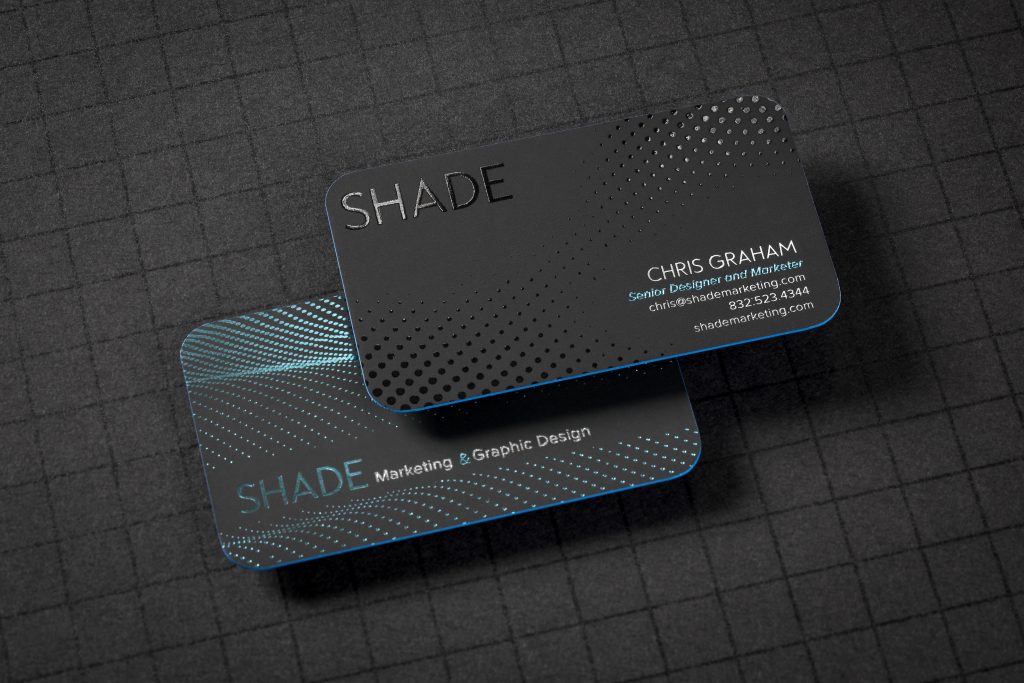
A foil edge that catches light. The perimeter of a heavy card is a surface most designs treat as a default — paper white, or the bonded interior layer left exposed. Treat it as a designed plane and a different card arrives. A foil edge along all four sides catches every light source in the room when the card moves. It signals tier in the half-second before the type is read.
Multi-Color Foil and Layered Techniques
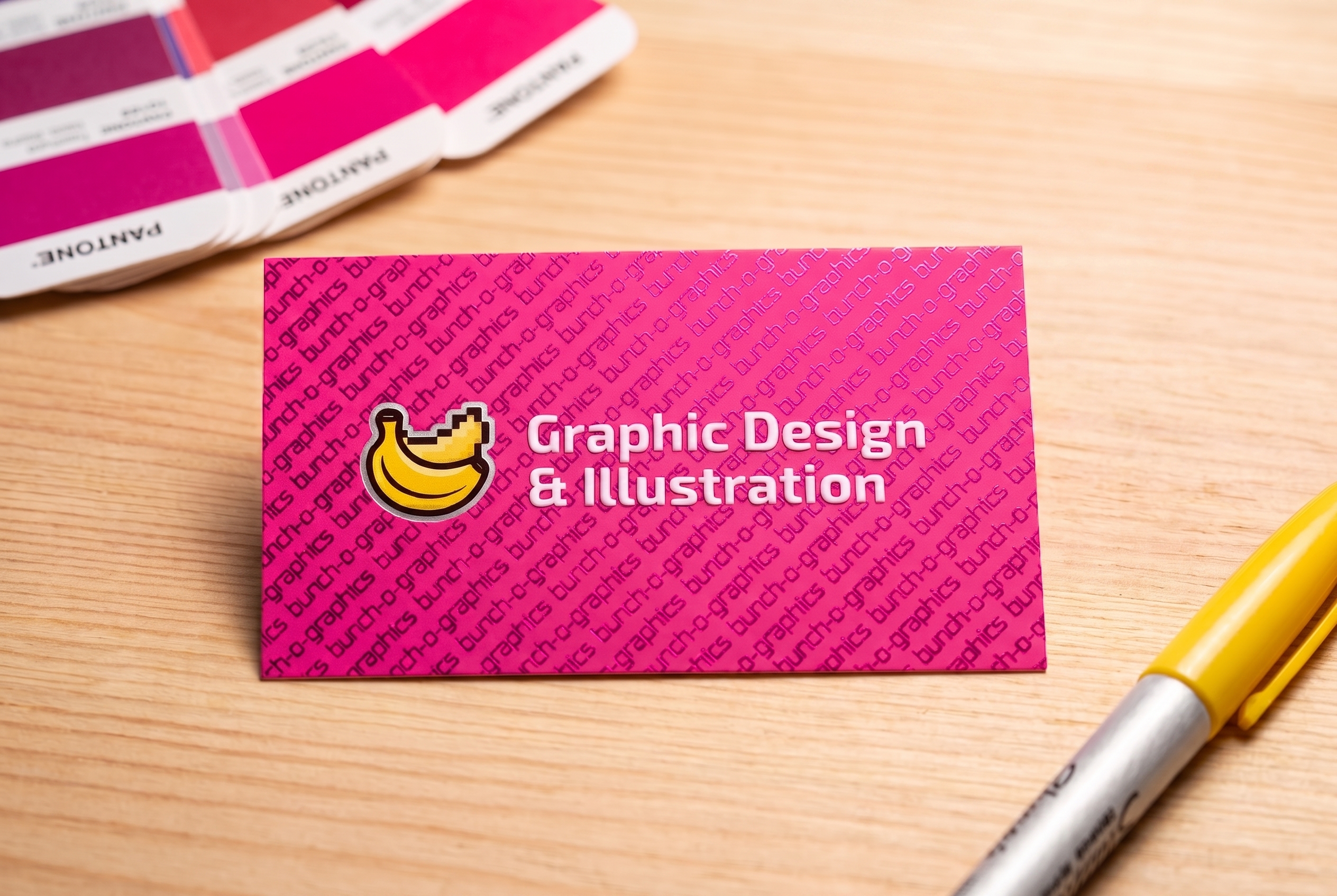
Multi-color foil on a single face. The industry default for foil business cards is one foil color, used as accent. The accent is a logo, a monogram, sometimes a rule line. A foil treatment that lays multiple foil colors against each other on a single face — without the second color washing out the first, without registration drifting between passes — turns the foil from accent into illustration. For example, photographs rendered in three foils. Two-color brand marks with tonal counterpoints. A typographic frame in a foil different from the type it surrounds. The card becomes a place to compose with metallic light the way a painter composes with pigment.
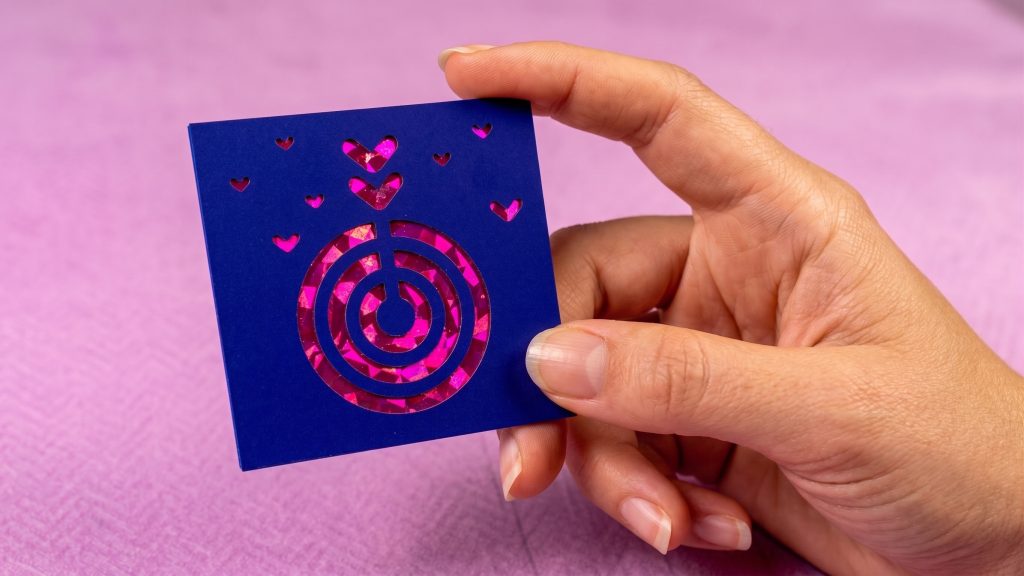
Face die cut, not edge die cut. Most die-cut business card services produce shaped edges. Rounded corners. Examples include a scalloped perimeter or a logo profile traced into the card’s outline. A different category of die cut goes through the face of the card — a circle, a letterform, a window, a deliberate negative space — and reveals the bonded interior layer’s color through that opening. The card becomes a layered object, not a flat one. Its interior layer becomes a designed surface that participates in the composition. Moreover, negative space becomes intentional.
Surface Treatments and Variable Elevation
Spot UV on top of foil. The standard premium card forces a choice: spot UV gloss on a matte field, or foil on a matte field. Both at once, on the same face, requires a registration tolerance that most platforms will not commit to. The combination — a foil illustration with a spot UV gloss laid directly on top of the foil to add a wet-looking high reflection over a metallic surface — produces a finish vocabulary almost no online print house produces. As a result, two distinct gloss heights register against each other under the fingertip. Visually, a metallic surface with a wet highlight which is a visual register the brain reads as expensive, the way a varnished oil painting reads as expensive next to a print.
Variable elevation. A card finish with one elevation across the surface is a finish. A card finish where one element sits at twice the height of another — a logo at three or five times the relief of the rule line beside it — is a structural composition. The fingertip walks the surface. The information hierarchy on the card is no longer purely a typographic decision. It is a tactile one. The most important element is the one your finger finds first.
You can compose with any of these as a single technique. You can compose with them in combination. The combination is where the work starts to look like nothing else in the SERP.
Where this vocabulary lives — the showroom
The full inventory of what we make using this vocabulary lives on our premium business cards page. It is the room you walk into if you want to see the finished work before the conversation, with the specs printed beside each finish so you can match what your eye sees to what your client will eventually hold. The cards there are the production cards, not renderings. They are the same cards your sample pack will arrive with.
What this set of specs does to a card
It changes what the card is for. A 2D card communicates an identity. A card built from this vocabulary does that too, but it also performs a small physical event when it arrives in a hand. The event is the thing that lingers after the conversation ends. Designers who have specified one of these cards for a client describe the same pattern back to me, almost always in the same words: the client kept turning it over. That is what happens when you give someone a card whose vocabulary they do not have yet. They look at it, feel it, put it down. Then they pick it back up and look again. The card is doing the work the conversation cannot finish.
Why We Are Not for Everyone (and Why That’s the Point)
A note on positioning, because designers ask, and because the honest answer is the one that earns the relationship.
SilkCards is not for every print job in a designer’s portfolio. We are not the printer to send a 200-card teacher-appreciation order to. The franchise that needs 5,000 identical cards at the lowest price is not our client. Volume work is not what we do, and we have no interest in pretending otherwise.
The way I think about it is simple. After twenty-five years inside the premium tier of this market, I see it the way a designer would think about specifying any product up the value chain. A Porsche, a Lamborghini, and a Mercedes are not for everyone. They are not trying to be. The fact that they are not trying to be is the source of their authority. Each serves a specific tier and does it well. Each is honest about which buyers it is for and which it is not. The buyer who needs reliable, fast, and inexpensive is right to pass them by. The buyer who is buying tier reads them correctly.
Why This Positioning Builds Designer Authority
Similarly, premium print is the same structure. Most designers already work with a stack of vendors — a fast-volume printer for the routine work, a local shop for the rush jobs, maybe a wide-format house for trade shows, maybe a packaging specialist. Adding SilkCards to that stack is additive. We are not asking you to displace the printer who serves you well on the routine work. We are asking for the slot in your vendor stack that opens when a client wants something the routine printer cannot make. A luxury launch. The brand identity for a $1M+ listing. Capital campaign collateral that has to read as premium on first touch. The boutique that wants a card that signals tier before the conversation begins. That is the project profile that maps to us. The rest belongs to the printers who do that work well.
The clean version of this, the one I would say to your face: we are a specialty manufacturer with a niche. We earn the slot by doing the niche work better than the all-purpose printer can. We do not earn it by being everywhere or by competing on cost. If your client portfolio includes work that needs premium tactile print, we are likely the right partner for those projects. If it does not, your existing vendor stack is probably already correct, and you can come back when the right project arrives.
That is the honest counsel.
The Alliance — How Designer Relationships Become Partnerships
How designers actually discover us is a story I learned by watching the order pattern, not by drawing a funnel diagram.
A designer almost never finds SilkCards by searching for a print partner. Rarely is the first order the designer’s own card. The pattern, repeated thousands of times, runs this way: an end client — a business owner, a real estate broker, a salon owner, a boutique founder — does the research, finds SilkCards through their own discovery path, and asks the designer they have already hired to please order the cards through us. That designer, doing what a good designer does for a client, files the order. The package arrives. Cards go to the client. What happens next is the way clients always react to a card built from the vocabulary above.
How the Relationship Deepens
Then something quiet happens. The designer, who has now seen one of our cards finished and in hand, designs their own card the same way. That second order, the designer-self-card, is almost always the one we trace back to a prior client-driven order three to six months earlier. We did not market to that designer. The client did, by handing them one of our finished pieces.
From that point on, the designer becomes a different kind of customer. They begin specifying premium tactile print proactively when their clients have the budget and the project profile for it. Over time, they become the person in the client’s vendor decision who knows that this category exists. That designer is not selling SilkCards. They are doing the work of a designer at a higher tier of craft, and we are the manufacturing partner who lets that tier be specifiable.
The Public Evidence of What Tactile Print Does
There is a documented public-scale version of this. Search any social platform for business card unboxings and a pattern shows up: dozens of creators, almost all of them with design instincts, filming the cards they ordered from us. We did not pay for that content. The creators made it because the card was worth filming. The pattern is large enough now that the channels rank for queries we never targeted. A hair stylist in our records ordered her own cards, loved them, designed cards for her co-workers, sent us the orders, and eventually became a small dealer of ours. She had design instincts. She did not have a design degree. The flywheel is craft-driven, not credential-driven.
The Pro path — your client never has to know our name
A version of this relationship exists for designers who specify SilkCards for client work on a recurring basis. We call it our Pro account, and the structure is one most designers find more comfortable than the alternative.
The structure is simple. Designers manage the relationship with us. Everything is presented to the client as the designer’s work, finished through the designer’s vendor network. The client does not have to know our name. The card is the work; the work is credited to the designer; the relationship between client and designer is unbroken. We stay invisible to your client by design, because that is what protects your professional position with them.
This is the doctrine we hold to because we used to be on the other side of it. When I was running the design service in 1997, the worst thing a vendor could do was insert themselves into the client conversation. The right relationship is the one where the client sees the designer’s work, not the printer’s brand. Our job in that relationship is to be the manufacturing partner who lets you say I had this made without having to explain who made it. The credit is yours.
The Designer-First Partnership Structure
This is the alliance the pillar of this article is built around. We provide the manufacturing dimension that AI cannot replicate. You provide the design eye, the client relationship, and the project judgment that decides when this dimension is the right call for a given job. Together, the work moves up the value chain into a tier where price compression and AI substitution stop being the conversation.
The Deeper Offer — Why Designers Come Back
The Pro account economics matter. The cards matter. Yet the reason designers come back to SilkCards repeatedly, over years, is none of those things.
It is something I caught myself feeling for the first time on the second project I ever designed-and-printed for a client. I delivered the printed piece. The client reacted to it. The reaction was not a polite thank-you. It was the small, involuntary expression of pleasure that a person makes when something they were paying for turns out to be more than they expected. The client did not know they had hired me to make them feel that. I did not know I had hired myself to learn what that felt like.
Every designer I have spoken to about this knows the feeling. Every time someone picks up a card you designed for them and the card is the conversation starter at the table — the moment when the room turns toward the person whose card it is, and the person whose card it is turns slightly toward you, the designer, in acknowledgment — you get a second-hand version of their pleasure. That is the offer that keeps designers coming back. Not the card. The spec sheet is not what keeps them coming back. There is no loyalty discount involved. The feeling of having made someone’s day in a way they will remember.
The Deeper Satisfaction of Physical Work
I still feel that anticipation when one of our orders ships out. Imagining the box being opened, that first card coming out of the slipcover, never gets old. I imagine the room it lands in. I am not always going to know what happens in that room, because we are 99% e-commerce and most of those rooms are far from our floor. But the imagining is the part of the work that keeps the lights on at our place. The deeper offer is not the product. It is the emotional value the designer feels when the client lights up, and the value the client feels when their customer lights up after that. That layered pride is what makes a card worth making. It is also what makes one worth ordering again.
The Trustpilot reviews that come in from our designer customers say a version of this almost every time. My clients are always impressed. On another level. Never going back. Read enough of them in sequence and you stop reading them as testimonials and start reading them as a single recurring sentence — we made someone’s day, and we want to feel that again.
That is the reason this article exists. Not to sell a card. To make sure designers who could be feeling that, repeatedly, know how to get there.
How to Test Drive SilkCards
So now, two paths. Both are real. Choose the one that matches where you are reading this from.
Path one — Request a sample pack. If this is the first time you have heard our name, the right next move is the physical evidence. We will send you a curated set of finished cards across the vocabulary above — silk laminate at 32pt, foil edge, multi-color foil, face die cut, spot UV on foil, variable elevation. Hold them. Hand them around your studio. Press a fingernail across the spot UV. Run a thumb along the foil edge. Look at the cards in three different rooms and three different lights. That is the only honest way to evaluate a tactile product, and it is the way I would do it if I were on your side of this transaction.
Path Two: Order Your Own Designer Card
Path two — Order your own card with DESIGNER40. If you already have a SilkCards sample in hand — from a mailer, from a peer, from a client project that landed on your desk — the next move is not another sample. It is to test-drive the product the way your clients will. Design your own card. Order a small quantity. Use it for a month. Watch what happens in your professional conversations. The designer-self-card discount is built for this exact path: forty percent off your first self-card order, code DESIGNER40.
Use DESIGNER40 on your designer self-card →
That is the entire offer in the article. There is no third path, no urgency timer, no scarcity claim. The work is the work. The samples will tell you whether we are the right partner for the kind of cards your portfolio is starting to make room for. If we are, we are here. If we are not, your existing vendor stack is correct.
Frequently Asked Questions
Questions About Materials and Specifications
The best paper for designer business cards depends on the finish the designer wants to specify. For 16pt cards, the major premium options are silk laminate, matte laminate, suede laminate, soft-touch, and uncoated mill papers like Mohawk Superfine. For 32pt cards, the determining question is whether the laminate finish is carried through the full thickness or whether the construction defaults to uncoated mill stock above 16pt. A layered 32pt card that holds silk or suede on every layer reads as the premium tier most designers are aiming for, with the hand feel preserved at the heavier weight.
Graphic designers should match the print partner to the project profile. Routine, high-volume, low-cost cards belong with a mass-market printer. Client work that requires premium tactile finishes — silk or suede at heavy weight, multi-color foil, face die cut, spot UV on foil, foil edges, variable elevation — belongs with a specialty premium manufacturer that has built the infrastructure for those finishes. SilkCards is one of those specialty manufacturers, with 27 years of operating history in the premium tier of the U.S. business card market.
Common Technical Questions
Yes. Foil and spot UV can be combined on a single business card face, with spot UV laid directly on top of the foil to add a high-gloss reflective layer over the metallic surface. This combination is not produced by most online print platforms because it requires registration tolerance and a press configuration that most platforms have not invested in. SilkCards produces this combination as a standard production option on premium tier business cards.
About Partnerships and Print Sourcing
For most online print houses, silk or suede finish business cards top out at 16pt. Above 16pt, the standard industry construction switches to uncoated mill paper, because the pre-manufactured paper stocks used at heavier weights do not carry a laminate finish. SilkCards produces silk and suede finish business cards at 32pt by building the card from layered, individually finished sheets bonded together — preserving the laminate hand feel through every layer of the thickness.
The best print partner for graphic designer business cards is the manufacturer whose capability set matches the project’s tier requirement. For routine, high-volume cards, a mass-market online printer is correct. For premium business cards for graphic designers and their luxury-tier clients — work that requires multi-color foil illustration, face die cut, spot UV on foil, foil edges, variable elevation, or silk and suede finishes carried at 32pt thickness — the right partner is a specialty premium manufacturer with the press infrastructure and registration tolerance to produce those combinations. SilkCards has operated in this premium tier for 27 years and produces business cards for graphic designers across the U.S. and internationally.
Partnership and Pro Account Questions
Designers who specify SilkCards for client work on a recurring basis can convert to a Pro account, which provides preferential pricing, dedicated production handling, and a confidential vendor relationship where the printed deliverable is presented to the designer’s client as the designer’s work, with SilkCards remaining invisible to the client. The relationship is initiated by completing the standard Pro account application and providing the typical portfolio and order-history documentation. The first step for most designers is to order a sample pack or a designer-self-card test order, which establishes the working relationship before any Pro conversion is discussed.
About Our Process and Partnership
A Closing Note
If you read this far and felt something shift, the shift is the point. The market is changing under designers in 2026, and the designers who move up the value chain into tactile work that AI cannot replicate are going to be working from a stronger position than the designers who try to compete with template generators on speed and price. Print, specifically premium tactile print, is one of the credible paths through. I have spent twenty-seven years building the manufacturing partner side of that path. The sample pack is the next step. After that, order your own designer card. Consequently, client work follows naturally when the right project arrives.
That is the counsel.
— Henry Fan
Founder, SilkCards
Chicago